
VIKTORIA-2
First-Line Hormone Receptor (HR)-positive, Human Epidermal Growth Factor Receptor 2 (HER2)-negative Advanced or Metastatic Breast Cancer
Click to view on ClinicalTrials.gov
Phase 3, open-label, randomized, clinical trial evaluating the efficacy and safety of gedatolisib plus fulvestrant and palbociclib for the treatment of patients with locally advanced or metastatic HR+/HER2- advanced breast cancer.
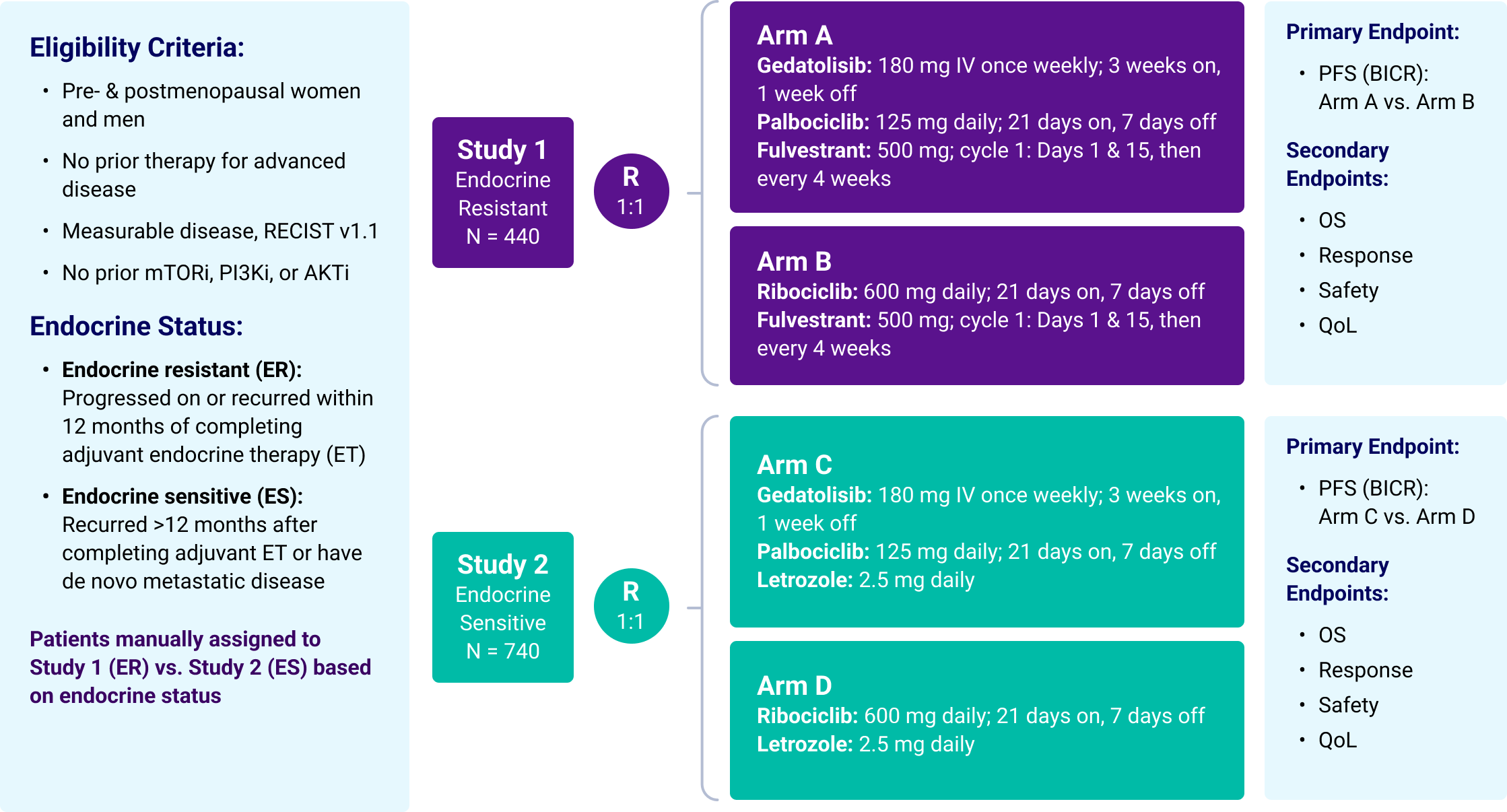
VIKTORIA-2 Study Schema
Abbreviations: AKTi, AKT inhibitor; BICR, blinded independent central review; HbA1c, hemoglobin A1c; HER2-, human epidermal growth factor receptor 2-negative; HR+, hormone receptor-positive; IV, intravenous; mTORi, mechanistic target of rapamycin inhibitor; OS, overall survival; PFS, progression-free survival; PI3Ki, phosphatidylinositol 3-kinase inhibitor; QoL, quality of life; R, randomization; RECIST, Response Evaluation Criteria in Solid Tumors.
About the Phase 3 VIKTORIA-2 Study

VIKTORIA-2 is a Phase 3, global, open-label, randomized, clinical trial designed to evaluate the efficacy and safety of gedatolisib plus a CDK4/6 inhibitor and endocrine therapy as first-line treatment for patients with HR+/HER2- ABC. Patients will be assigned manually according to their endocrine sensitivity status to either Study 1 (endocrine-resistant) or Study 2 (endocrine-sensitive) and subsequently be randomized 1:1 to either investigational treatment or standard-of-care control.
Study 1 is expected to enroll approximately 440 patients with treatment-naïve endocrine-resistant ABC whose cancer progressed while receiving or within 12 months of completing adjuvant endocrine therapy. The trial will evaluate the efficacy and safety of gedatolisib combined with palbociclib and fulvestrant (Arm A) compared to ribociclib combined with fulvestrant (Arm B).
Study 2 is expected to enroll approximately 740 subjects with treatment-naïve endocrine-sensitive ABC whose cancer relapsed or progressed 12 months or more after completion of (neo)adjuvant endocrine therapy, or those with de novo metastatic disease without prior endocrine therapy exposure. The trial will evaluate the efficacy and safety of gedatolisib combined with palbociclib and letrozole (Arm C) compared to ribociclib combined with letrozole (Arm D).
The clinical trial primary endpoints for the VIKTORIA-2 clinical trial are progression-free survival, per RECIST 1.1 criteria, as assessed by BICR.
This global trial is expected to enroll subjects at up to 200 clinical sites across North America, Europe, Latin America, and Asia.