
VIKTORIA-1

A Phase 3 trial evaluating gedatolisib as a 2nd-line treatment for HR+/HER2- advanced breast cancer

VIKTORIA-1 is a Phase 3 study evaluating gedatolisib plus fulvestrant with and without palbociclib in patients previously treated with a CDK4/6 therapy and an aromatase inhibitor.

Approximately 701 eligible patients whose PIK3CA mutational status has been determined will be enrolled.

Eligible patients who do not have confirmed PIK3CA mutations (WT) will be randomly assigned (1:1:1) to receive a regimen of either gedatolisib, palbociclib, and fulvestrant (Arm A); gedatolisib and fulvestrant (Arm B); or fulvestrant (Arm C).

Eligible patients who have confirmed PIK3CA mutations (MT) will be randomly assigned (3:3:1) to receive a regimen of either gedatolisib, palbociclib, and fulvestrant (Arm D); alpelisib and fulvestrant (Arm E); or gedatolisib and fulvestrant (Arm F).

VIKTORIA-1 Study Schema
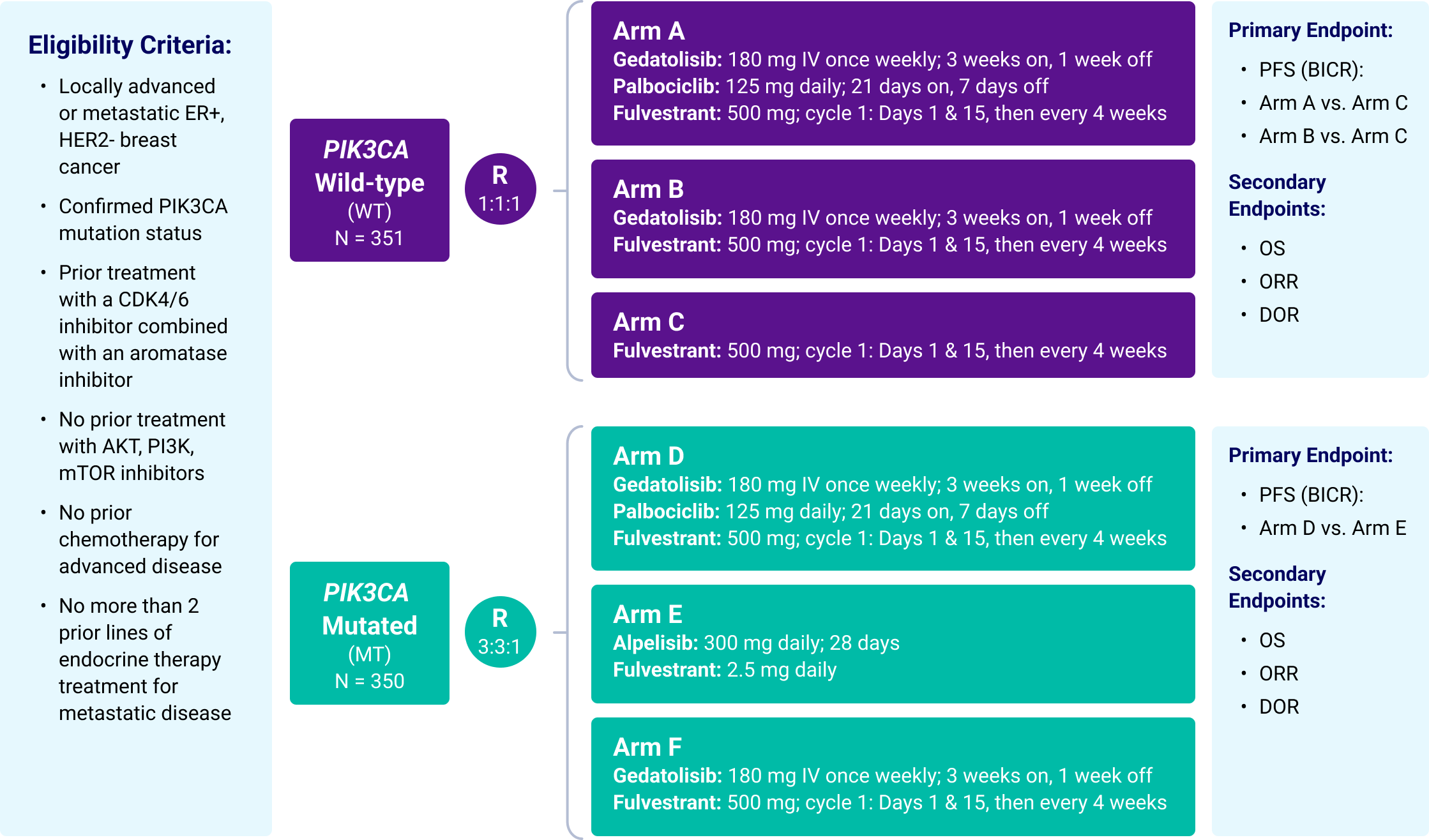
Abbreviations: AKTi, AKT inhibitor; BICR, blinded independent central review; DOR, duration of response; HbA1c, hemoglobin A1c; HER2-, human epidermal growth factor receptor 2-negative; HR+, hormone receptor-positive; ER+, estrogen receptor-positive; IV, intravenous; mTORi, mechanistic target of rapamycin inhibitor; ORR, overall response rate; OS, overall survival; PFS, progression-free survival; R, randomization.

Rationale

Simultaneous inhibition of the PAM (PI3K/AKT/mTOR) pathway with gedatolisib, the CDK4/6 pathway with palbociclib, and the estrogen receptor pathway with fulvestrant, is intended to disrupt complex cooperation between these pathways to inhibit tumor growth.

Available evidence indicates that resistance to CDK4/6 inhibition is a transient adaptive mechanism, most likely involving the PAM pathway. Continuing CDK4/6 inhibition in combination with PAM inhibition in patients who progressed on their prior CDK4/6 inhibitor is expected to both block the reactivated CDK4/6 pathway and prevent adaptive activation of the PAM pathway.

Patients whose disease progressed on a CDK4/6 inhibitor may thus potentially benefit from continued treatment with a CDK4/6 and ER inhibitor when it is combined with a PAM inhibitor as their next line of therapy.